What Separates Managed Email Infrastructure from Shared Platforms
The economics of email infrastructure are counterintuitive. A managed SMTP relay priced at €0.0009 per email looks dramatically cheaper than dedicated infrastructure — until you factor in that "delivery" at a shared ESP is not the same as "inbox delivery." An email that lands in Gmail's spam folder still counts as delivered. It costs you the same price per email. Your campaign statistics show 100% deliverability while your open rate sits at 8%.
Dedicated infrastructure changes the economics. When your IP reputation is isolated from every other sender in the world, your inbox placement is a direct function of your own sending behavior — your list quality, your complaint rate, your engagement signals. Good operators with clean lists consistently see 95–98% inbox placement. That 15–20% inbox placement improvement over shared infrastructure translates directly to campaign revenue at scale.
At 1 million emails per month with a €0.10 revenue-per-inbox-delivered email, the difference between 78% inbox placement (typical shared ESP) and 97% inbox placement (dedicated infrastructure) is €19,000 per month in additional revenue. The cost difference between the platforms is typically €300–€600 per month. The ROI calculus is rarely close.
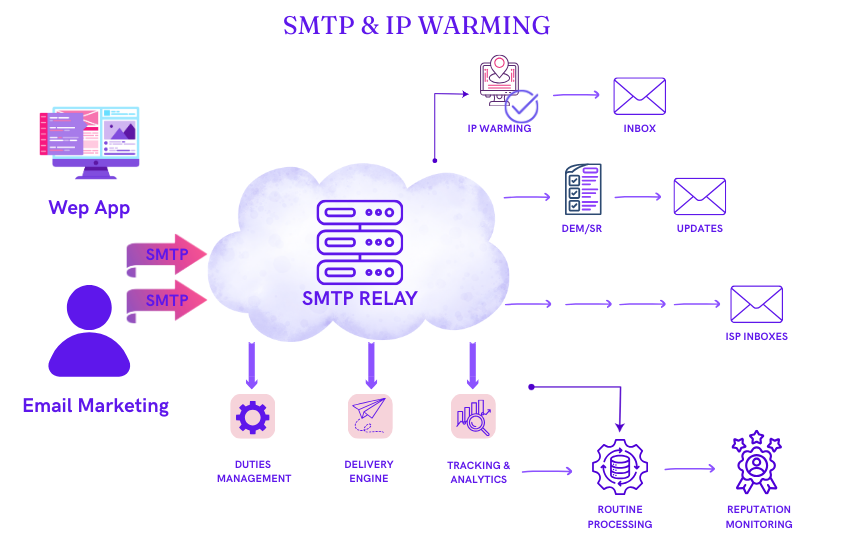
Beyond inbox placement, dedicated infrastructure provides operational capabilities that shared platforms fundamentally can't offer: per-ISP domain-level throttle configuration, custom retry logic for specific bounce categories, real-time queue depth monitoring, stream isolation between sending types, and postmaster relationship access for fast resolution of ISP-level blocks.
These aren't premium features you unlock with a higher plan. They're structural properties of dedicated infrastructure that determine whether your email program is truly yours to control — or whether you're a passenger in someone else's reputation ecosystem.
The Infrastructure Stack We Build
Every client infrastructure deployment starts from the same architectural principles, then gets configured for the specific volume, use case, and ISP mix of the sending program:
- MTA selection and configuration: PowerMTA for operations above 1 million emails/day where its native per-domain throttling and structured accounting logs pay for the license; optimized Postfix for operations where the open-source toolchain is sufficient.
- IP allocation and authentication: Dedicated IPv4 IPs with valid PTR records, FCrDNS verification, SPF records for all sending domains, 2048-bit DKIM keys with documented rotation procedures, and DMARC at minimum p=none with active aggregate report monitoring.
- Stream architecture: Separate IP pools for transactional, bulk marketing, and cold outreach. Each pool operates in complete reputation isolation — a complaint spike in one stream cannot affect inbox placement in another.
- Monitoring stack: 24/7 DNSBL monitoring across Spamhaus ZEN, Barracuda BRBL, URIBL, and 47 additional lists. Gmail Postmaster Tools domain and IP reputation tracking. Microsoft SNDS integration. Yahoo FBL registration. Real-time queue depth alerting.
- Bounce and complaint processing: Automated hard bounce suppression, complaint-to-unsubscribe processing, and daily bounce rate analysis by ISP and list segment.
Volume Thresholds and When to Invest in Dedicated Infrastructure
The conventional wisdom is that dedicated infrastructure becomes economically justified at approximately 500,000 emails per month. That threshold is a reasonable starting point but misses a more important consideration: the nature of the email program, not just the volume.
A SaaS company sending 100,000 password reset and onboarding emails per month has more at stake per email than a newsletter publisher sending 2 million monthly marketing emails. If even 5% of password reset emails land in spam, users can't access their accounts — the deliverability failure has immediate, measurable product impact. For this use case, dedicated infrastructure is justified at volumes well below the conventional threshold.
Conversely, a marketing program with a highly engaged list, excellent content, and consistent sending practices may achieve acceptable inbox placement on shared infrastructure up to 1 million+ emails per month before the economics clearly favor dedicated. Volume and use case must be evaluated together.